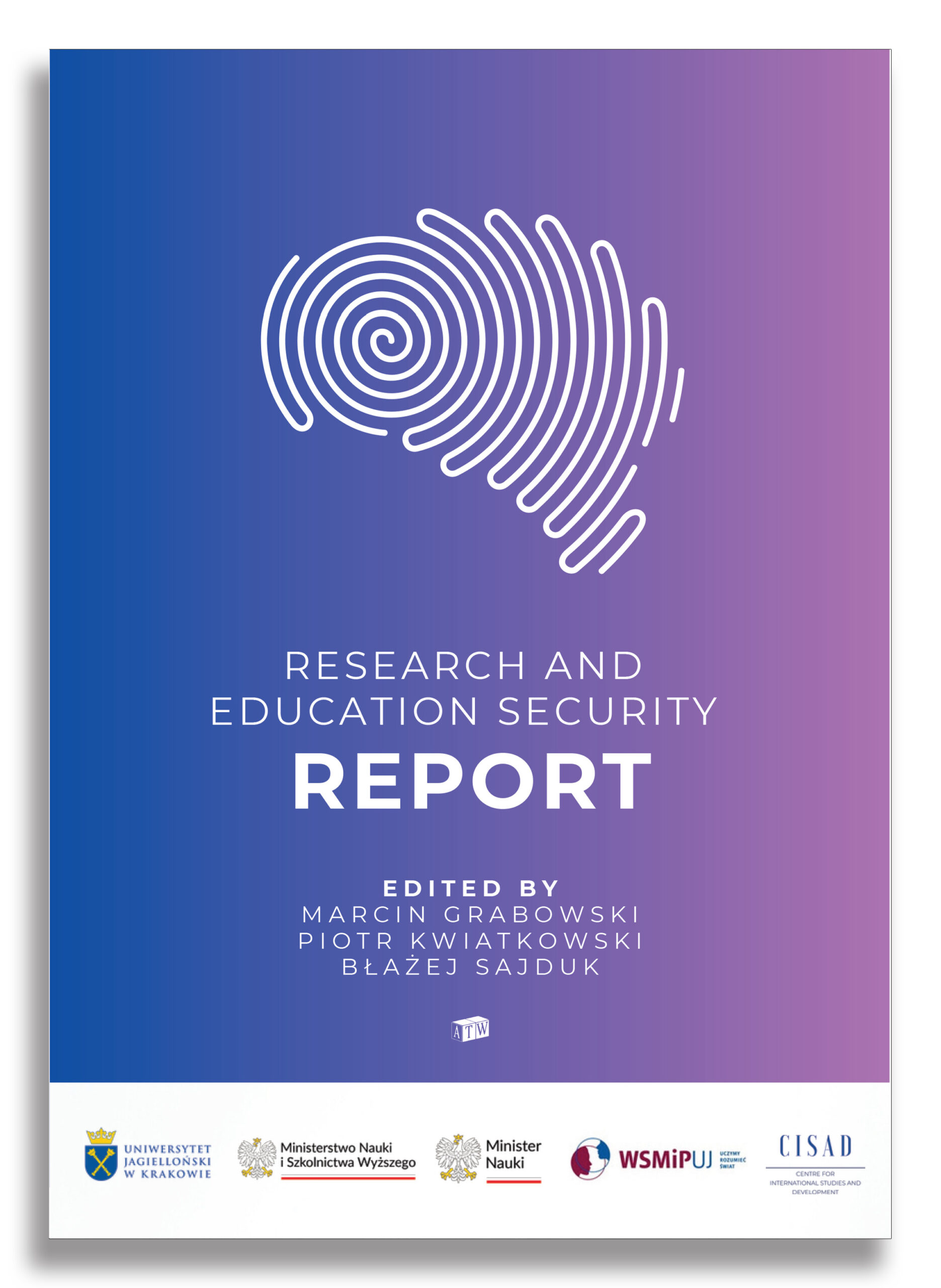
Title: Research and Education Security Report
Editors: Marcin Grabowski, Piotr Kwiatkowski, Błażej Sajduk
Publishing date: 02.2026
ISBN: 978-83-68278-11-8 (e-book)
DOI: https://doi.org/10.59862/k7m2x9q4r8
Creative Commons

Copyright: Ministerstwo Nauki i Szkolnictwa Wyższego/ The Polish Ministry of Science and Higher Education
From introduction „Research and Education Security Report”:
The Research and Education Security Report, co-authored by a group of mostly European scholars, aims at analyzing and illustrating challenges, but to a degree also opportunities, connected with academia, research conducted by universities and other institutions, exchange of students and scholars, as well as abuses made by nation states benefiting from features of the research and education community. Understanding that academia cannot be isolated from external influences as it benefits greatly from openness to the world, researchers, students, and R&D sector managers should be aware of the kinds of risks that exist, and try to minimize them without violating basic principles of the broadly understood academia, hence openness to new ideas, new people, revolutionary developments, and contradictions that often bring inventions and provide progress.
The entire volume is available for download at the following link: E-BOOK
Individual chapters are available below:
Marcin Grabowski, Piotr Kwiatkowski, Błażej Sajduk
Foreword
DOI https://doi.org/10.59862/k7m2x9q4r8/00
I. INTELLIGENCE: CHALLENGES AND OPPORTUNITIES IN ACADEMIA
Niklas Swanström & Filip Borges Månsson,
Balancing Security and Innovation: A Policy Perspective
DOI https://doi.org/10.59862/k7m2x9q4r8/01
Artur Gruszczak,
Academic Espionage: Finding a Better Balance between Open Science and Security Imperatives
DOI https://doi.org/10.59862/k7m2x9q4r8/02
Andrii Davydiuk,
Cybersecurity in the Academic Environment: Scientific Institutions as Targets of Cyber-Attacks
DOI https://doi.org/10.59862/k7m2x9q4r8/03
Aleksi Kajander,
Research Data during an Armed Conflict: An Overlooked Target?
DOI https://doi.org/10.59862/k7m2x9q4r8/04
II. CYBERSECURITY AND TECHNOLOGICAL SECURITY IN RESEARCH
Sławomir Wyciślak,
A Systemic Approach to Cybersecurity in International Research Projects. The Role of Digital Platforms
DOI https://doi.org/10.59862/k7m2x9q4r8/05
Izabela Albrycht,
Cyberthreats to the Science and Research Sector as a Challenge to National Security and Economic Competitiveness
DOI https://doi.org/10.59862/k7m2x9q4r8/06
Marek Czajkowski,
Safety and Security of Space-Enabled Education/Learning and Research
DOI https://doi.org/10.59862/k7m2x9q4r8/07
Paweł Frankowski,
Knowledge without Borders: Securing Technology and Data in Global Academic Collaboration
DOI https://doi.org/10.59862/k7m2x9q4r8/08
III. CASE STUDIES: CHINESE AND RUSSIAN INFLUENCE
Marcin Przychodniak,
The US “China Initiative” in the Face of Challenges in Scientific and Research Cooperation with the People’s Republic of China. Relevance to the EU
DOI https://doi.org/10.59862/k7m2x9q4r8/09
Błażej Sajduk,
The Importance of Technological Standards in Chinese Foreign Policy
DOI https://doi.org/10.59862/k7m2x9q4r8/10
Vladimir Sazonov,
Russian Influence Activities and Espionage in the Estonian Academic Environment: The Case of Viacheslav Morozov, a Russian GRU Spy at the University of Tartu
DOI https://doi.org/10.59862/k7m2x9q4r8/11
Marcin Mateusz Jerzewski,
Situating Academia in Economic Security Strategies: Lessons from Taiwan
DOI https://doi.org/10.59862/k7m2x9q4r8/12
IV. KNOWLEDGE SECURITY AND RESEARCH ETHICS
Eliza Kotowska,
Addressing Disinformation Vulnerabilities in International Students and Paths to Resilience
DOI https://doi.org/10.59862/k7m2x9q4r8/13
Leo Eigner,
Knowledge Security: A New Policy Concept for Science and Politics
DOI https://doi.org/10.59862/k7m2x9q4r8/14
David O’Brien,
Decolonizing Knowledge: The Practical and Ethical Challenges of Researching “Sensitive” Topics in and about China
DOI https://doi.org/10.59862/k7m2x9q4r8/15
Melissa Shani Brown,
Internationalization, the Securitization of Knowledge, and Trans-National Repression within and beyond the Classroom
DOI https://doi.org/10.59862/k7m2x9q4r8/16
This publication is financed from the budget of the Polish Ministry of Science and Education as part of the implementation of the task entitled ‘Organization of the Conference: Research and Education Security (RES)’