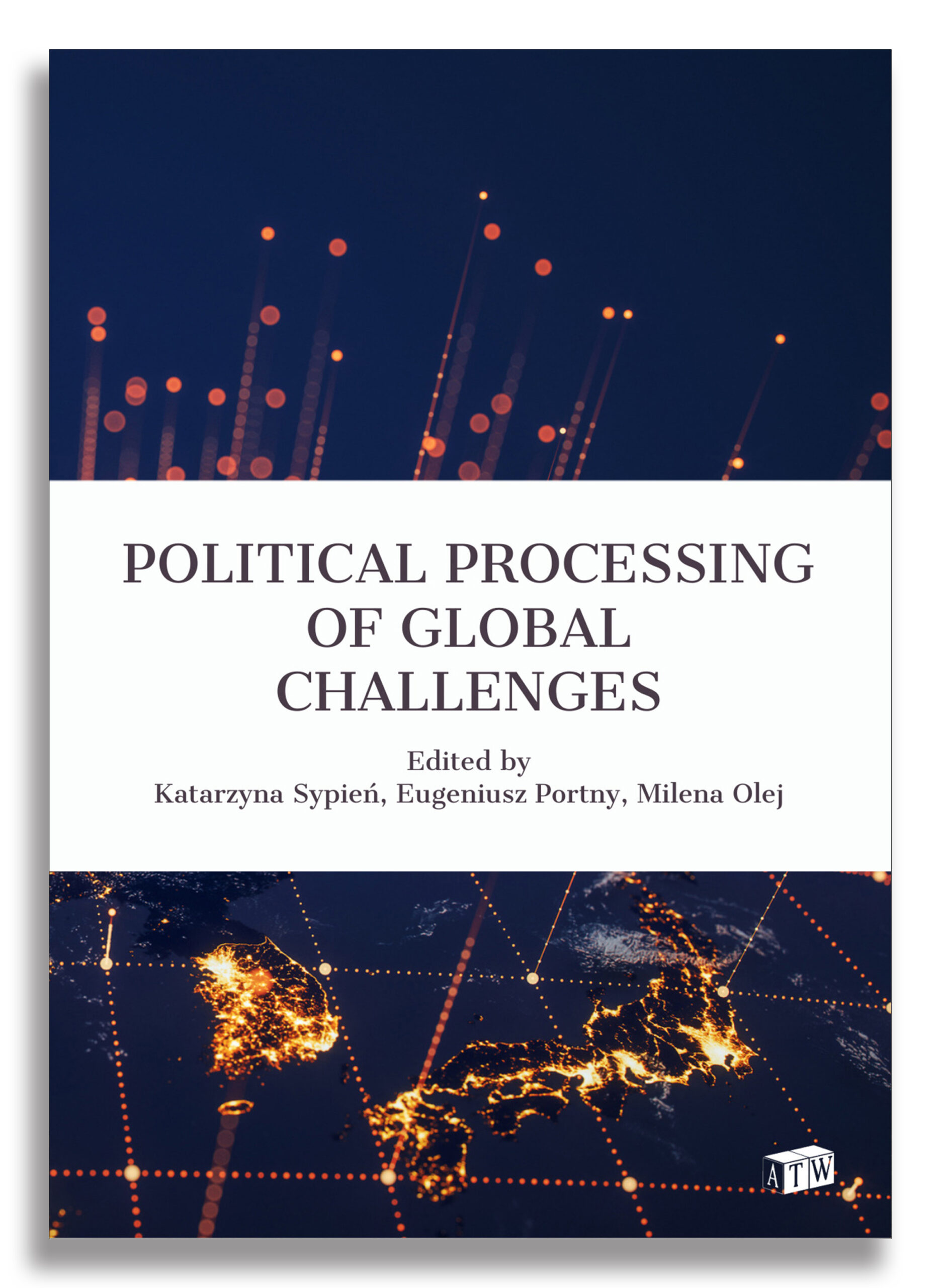

Title: Political Processing of Global Challenges
Scientific Editors: Katarzyna Sypień, Eugeniusz Portny, Milena Olej
Publishing review:
Dr hab. Robert Kłaczyński, prof. UKEN
Dr hab. Jakub Zajączkowski
Publishing date: November 2026
ISBN: 978-83-68278-15-6 (e-book)
DOI: https://doi.org/10.59862/p7k4m2xq
License: Creative Commons Attribution–NonCommercial–NoDerivatives 4.0 International (CC BY-NC-ND 4.0)

About the Book „Political Processing of Global Challenges”:
This edited volume examines how global challenges are politically interpreted, institutionally mediated and translated into policy responses at national, regional and international levels. It develops the concept of political processing through three interconnected thematic axes: the interpretation and framing of global challenges, global governance and the domestic filtering of norms, and national policy responses, implementation and legitimation.
Drawing on interdisciplinary perspectives from political science, international relations and public policy studies, the volume brings together eleven chapters addressing climate governance, economic sanctions, technological sovereignty, artificial intelligence, military innovation, nuclear waste management, agricultural policy, public health and migration.
Through diverse regional and national case studies, the authors explore how institutional arrangements, political interests, strategic narratives and administrative capacities shape responses to transboundary pressures. Particular attention is paid to securitisation, norm localisation, selective implementation and the divergence between formal commitments and policy outcomes.
The volume provides an analytical framework for understanding the political mediation of contemporary global challenges and the complex relationship between global governance and domestic policy-making.
Table of Contents
Katarzyna Sypień, Milena Olej, Eugeniusz Portny
The relational production of policy responses
DOI: 10.59862/p7k4m2xq01
Jakub Mądry
Securitisation of EU ETS 2 in the European Parliament
DOI: 10.59862/p7k4m2xq02
Katarzyna Sypień
Communicating climate change by elites: a case study of Vietnam
DOI: 10.59862/p7k4m2xq03
Milena Olej
Framing, filtering, and friction: the domestic mechanics of the Belt and Road Initiative
DOI: 10.59862/p7k4m2xq04
Duong Do
China’s financial transformation in response to US sanctions in 2018–2025: the case of Renminbi
DOI: 10.59862/p7k4m2xq05
Aleksander Niepokój
Artificial intelligence and technological sovereignty in Kazakhstan: state strategies in the third decade of the 21st century
DOI: 10.59862/p7k4m2xq06
Jan Jakub Kopeć
The struggle for interoperability and ethics: how Türkiye’s “drone diplomacy” and industrial logic challenge NATO’s artificial intelligence standards
DOI: 10.59862/p7k4m2xq07
Aleksandra Oczkowicz
Nuclear waste management as a test of state capacity for long-term political commitment in Finland and Sweden
DOI: 10.59862/p7k4m2xq08
Tomasz Kucharski
The impact of the Russian Federation’s invasion of Ukraine on Polish regulations concerning agricultural products
DOI: 10.59862/p7k4m2xq09
Julia Tymczyszyn
Public health framing and policy outcomes in Canada’s opioid crisis response
DOI: 10.59862/p7k4m2xq10
Viera Carolina López Lasunova
Politicisation of Haitian immigration in the Dominican Republic
DOI: 10.59862/p7k4m2xq11
Funding
The research for this publication has been supported by a grant from the Priority Research Area – Faculty of International and Political Studies under the Strategic Programme Excellence Initiative at Jagiellonian University.