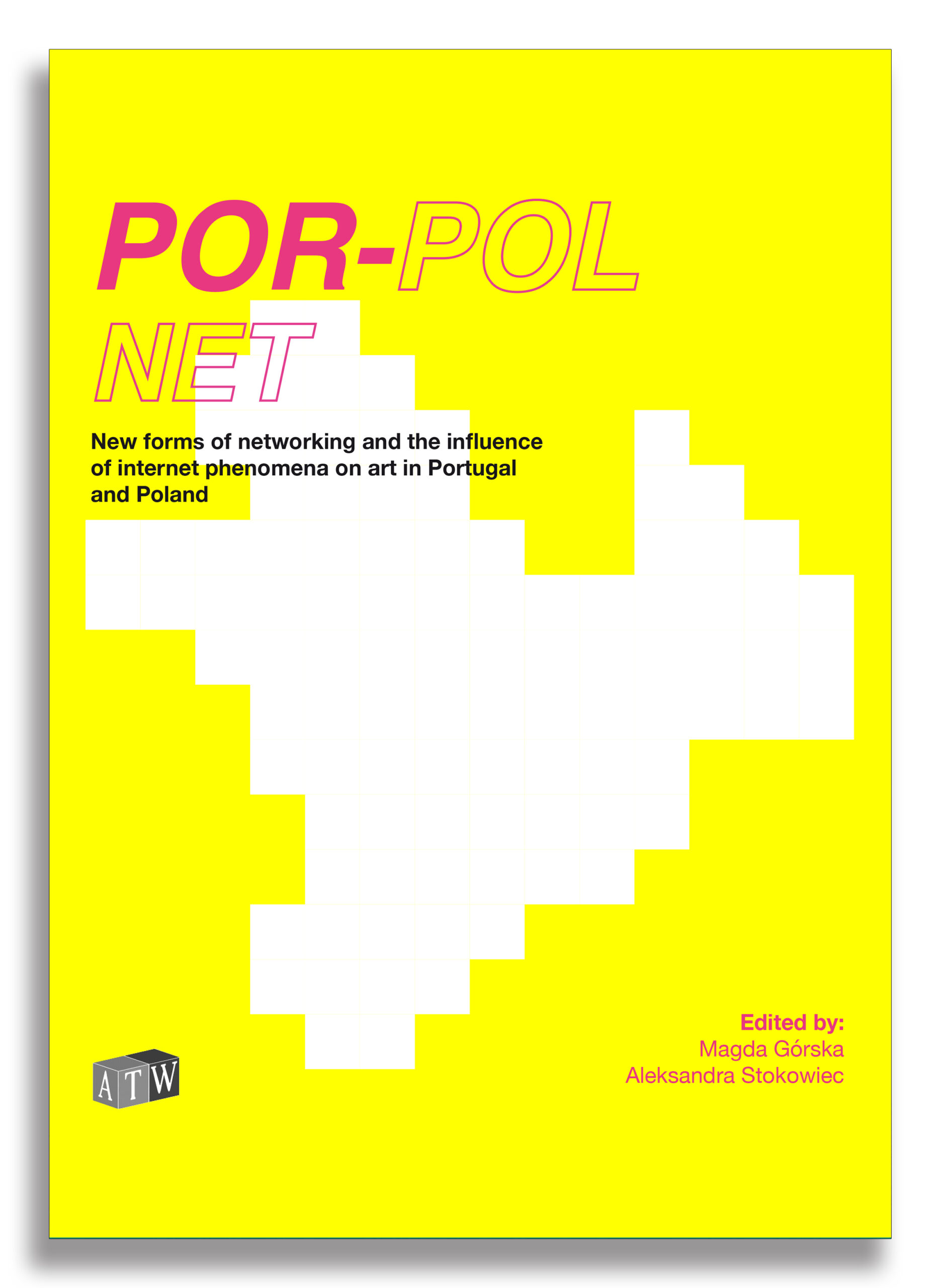
Title: POR-POL NET. New forms of networking and the influence of internet phenomena on art in Portugal and Poland
Editors: Magda Górska, Aleksandra Stokowiec
Publishing date: 2025
ISBN: 978-83-68278-05-7
DOI: https://doi.org/10.59862/F7k2B9xQ
The Project was generously supported by:
– IDUB – Nicolaus Copernicus University in Toruń
– Doctoral School of Humanities, Theology and Arts – Academia Artium Humaniorum (AAH)
– Centre for Comparative Studies at the University of Lisbon
– Adam Mickiewicz Institute in Warsaw
From Introduction:
The following publication results from the POR-POL NET project initiated at the end of 2022 as an attempt to present a critical overview of the most recent phenomena related to net art, software art, and electronic literature. Recognising that many of such works are a product of the intertwined realms of contemporary culture and technology, especially as regards experimentation with communication media used both as tools and objects of creative examination, the initiative intended to put artistic curiosity and academic inquisitiveness in dialogue. Its other objective was to confront the approaches of at least two different generations, along with two conflicting notions of the internet as, on the one hand, a vehicle of subversion while, on the other, an epitome of uniformity and globalisation. This last dichotomy – which essentially boils down to a variation on the theme of the tensions between the periphery and the centre, the grassroots and the formal – resulted in the idea of taking a closer look at the borders, edges and other liminal spaces as these areas where the arrival of major influences often coincides with the emergence of unique variations. Consequently, the project focused on Poland and Portugal as two extremes of the European continent and was developed in cooperation with both well-established institutions and some smaller, independent galleries. Within this setting, the perceived distance between East and West (be it geographical or symbolic) overlapped with the shared experience of marginality, which in turn carried a promise of retracing some original strategies for bridging gaps and making connections, while highlighting the points of convergence and radical difference.
The entire volume is available for download at the following link: POR-POL NET
Individual chapters – critical essays – are available below:
Aleksandra Stokowiec
Art and practice-based research in the post-internet era: the example of POR-POL NET project
DOI: https://doi.org/10.59862/F7k2B9xQ-01
Patrícia Gouveia
From cyber feminism to techno feminism, net.art and the spread of digital culture
DOI: https://doi.org/10.59862/F7k2B9xQ-02
Piotr Puldzian Płucienniczak
Remnants of the future. Artefacts of polish cybernetic poetry as seen today
DOI: https://doi.org/10.59862/F7k2B9xQ-03
Martyna Kopeć
Lostwave: forgotten music in the digital era
DOI: https://doi.org/10.59862/F7k2B9xQ-04
Bruno Ministro
Flaws in the flow: xerox, digital media and glitch
DOI: https://doi.org/10.59862/F7k2B9xQ-05
Ana Matilde Sousa
Beyond the brush: exploring the intersection of art and technology in Hetamoé’s pen-plotted paintings
DOI: https://doi.org/10.59862/F7k2B9xQ-06
Lorena Ramos Lomba
GIF as an artistic support
DOI: https://doi.org/10.59862/F7k2B9xQ-07
Pedro Ferreira
Things I Do When I’m Bored
DOI: https://doi.org/10.59862/F7k2B9xQ-08
Rafaela Nunes
Artefact-beings: hybridising painting through artificial intelligence
DOI: https://doi.org/10.59862/F7k2B9xQ-09